引言
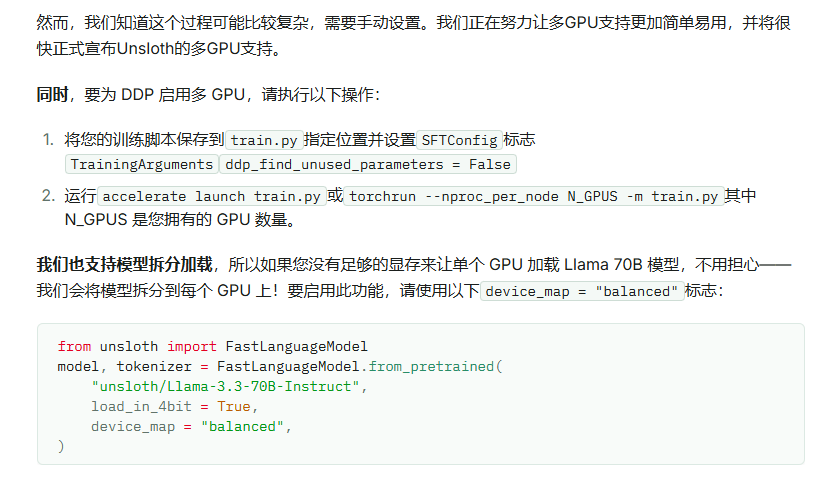
使用 Unsloth 进行多 GPU 训练 参考官方发布的公告,本篇博客意在测试unsloth的多卡训练的情况。
同时,也有开源项目实现了更为简便的并行操作,如: opensloth。
大致介绍unsloth: Unsloth 是一个面向大语言模型(LLM)训练与微调的高效框架,核心目标是——让用户在极低显存下高效地训练或微调大模型。它主要针对个人研究者、小规模 GPU 环境进行了大量优化。
- 极致显存优化(Ultra-Memory Efficient): 如支持 4bit / 8bit 量化加载(QLoRA 技术)
- 高性能实现(Fast Runtime):对 Hugging Face transformers 的 Trainer 做底层优化。内置 CUDA 加速算子,支持 FlashAttention、PagedAttention 等。实际训练速度通常比原生 HF 微调快 2–5 倍。
- 简洁易用的接口(Simple API):主体函数 FastLanguageModel.from_pretrained() 与 Hugging Face 接口保持一致
- 多种支持:支持 PEFT / LoRA / QLoRA、分布式与多 GPU 支持(Distributed Ready)、兼容 Hugging Face 模型与 tokenizer等;
环境说明
本次测试的环境搭建主要依托unsloth框架。
安装指导:
pip install --upgrade unsloth
pip show unsloth,结果如下:
Name: unsloth
Version: 2025.11.2
Summary: 2-5X faster training, reinforcement learning & finetuning
Home-page: http://www.unsloth.ai
Author: Unsloth AI team
Author-email: info@unsloth.ai
License-Expression: Apache-2.0
Location: /home/lihao/miniconda3/envs/unsloth_upgrade/lib/python3.11/site-packages
Requires: accelerate, bitsandbytes, datasets, diffusers, hf_transfer, huggingface_hub, numpy, packaging, peft, protobuf, psutil, sentencepiece, torch, torchvision, tqdm, transformers, triton, trl, tyro, unsloth_zoo, wheel, xformers
Required-by:
pip show accelerate结果如下:
Name: accelerate
Version: 1.5.2
Summary: Accelerate
Home-page: https://github.com/huggingface/accelerate
Author: The HuggingFace team
Author-email: zach.mueller@huggingface.co
License: Apache
Location: /home/lihao/miniconda3/envs/unsloth_upgrade/lib/python3.11/site-packages
Requires: huggingface-hub, numpy, packaging, psutil, pyyaml, safetensors, torch
Required-by: peft, trl, unsloth, unsloth_zoo
训练
在encoder-only模型上测试unsloth
# unsloth_modernbert_imdb.py

from unsloth import FastModel
from transformers import AutoModelForSequenceClassification, AutoTokenizer
from peft import LoraConfig, get_peft_model, TaskType

import os
import torch
import torch.nn as nn
from datasets import load_dataset
from transformers import (
    TrainingArguments,
    Trainer,
    DataCollatorWithPadding,
)
import evaluate
import numpy as np

# ----------------- 配置 -----------------

MODEL_NAME = "answerdotai/ModernBERT-base"
OUTPUT_DIR = "./imdb_unsloth_lora"
MAX_SEQ_LENGTH = 512
NUM_LABELS = 2
NUM_EPOCHS = 3
PER_DEVICE_BATCH = 8
GRAD_ACCUM_STEPS = 4
LEARNING_RATE = 2e-5
WEIGHT_DECAY = 0.01
LOGGING_STEPS = 50
EVAL_STEPS = 500
SEED = 3407
USE_FP16 = True

# IMDB 标签映射(用于正确输出和兼容性)

id2label = {0: "NEGATIVE", 1: "POSITIVE"}
label2id = {"NEGATIVE": 0, "POSITIVE": 1}

# ----------------- 加载数据 -----------------

raw_datasets = load_dataset("imdb")
full_train_dataset = raw_datasets["train"]  # 25000 样本

# 从训练集中划分 7:2:1 (17500 train, 5000 val, 2500 test)

shuffled_train = full_train_dataset.shuffle(seed=SEED)
train_dataset = shuffled_train.select(range(17500))  # 70%
val_dataset = shuffled_train.select(range(17500, 22500))  # 20%
test_dataset = shuffled_train.select(range(22500, 25000))  # 10%

# ----------------- 加载模型和 tokenizer -----------------

# 使用 FastModel 加载带分类头的模型,full_finetuning=True 避免加载冲突

model, tokenizer = FastModel.from_pretrained(
    model_name=MODEL_NAME,
    max_seq_length=MAX_SEQ_LENGTH,
    auto_model=AutoModelForSequenceClassification,
    num_labels=NUM_LABELS,
    id2label=id2label,
    label2id=label2id,
    dtype=torch.float16, # 坑

    load_in_4bit=False,  # 启用 4-bit 量化,节省内存 # 不启用

    full_finetuning=True,  # 先完整加载,避免 auto_model 冲突

)

# for name, _ in model.named_modules():
#     print(name)
# input()

# ----------------- 打印可训练参数函数 -----------------

def print_trainable_parameters(model):
    trainable = 0
    all_param = 0
    for _, param in model.named_parameters():
        all_param += param.numel()
        if param.requires_grad:
            trainable += param.numel()
    print(f"Trainable params: {trainable} / {all_param} ({100 * trainable / all_param:.2f}%)")

# ----------------- LoRA 配置(加载后应用) -----------------

lora_config = LoraConfig(
    task_type=TaskType.SEQ_CLS,
    r=16,
    lora_alpha=16,
    lora_dropout=0.0,
    # target_modules=["query", "key", "value", "dense"],  # ModernBERT 注意力层

    target_modules=["Wqkv", "Wo", "Wi"],  # ModernBERT 注意力层

)
# 应用 LoRA:冻结基模型,只训练适配器

model = get_peft_model(model, lora_config)
print_trainable_parameters(model)  # 现在应显示 ~0.5-1% 可训练参数

# ----------------- 数据预处理 -----------------

def preprocess_function(examples):
    tokenized = tokenizer(
        examples["text"],
        truncation=True,
        max_length=MAX_SEQ_LENGTH,
        padding=False
    )
    tokenized["labels"] = examples["label"]
    return tokenized

# 预处理所有数据集

train_dataset = train_dataset.map(preprocess_function, batched=True, remove_columns=train_dataset.column_names)
val_dataset = val_dataset.map(preprocess_function, batched=True, remove_columns=val_dataset.column_names)
test_dataset = test_dataset.map(preprocess_function, batched=True, remove_columns=test_dataset.column_names)

# ----------------- DataCollator & Metrics -----------------

data_collator = DataCollatorWithPadding(tokenizer)
accuracy = evaluate.load("accuracy")
f1 = evaluate.load("f1")

def compute_metrics(eval_pred):
    logits, labels = eval_pred
    preds = np.argmax(logits, axis=-1)
    acc = accuracy.compute(predictions=preds, references=labels)["accuracy"]
    f1_micro = f1.compute(predictions=preds, references=labels, average="binary")["f1"]
    return {"accuracy": acc, "f1": f1_micro}

# ----------------- TrainingArguments -----------------

training_args = TrainingArguments(
    output_dir=OUTPUT_DIR,
    eval_strategy="epoch",
    # eval_steps=EVAL_STEPS,

    save_strategy="epoch",
    # save_steps=EVAL_STEPS,

    save_total_limit=1,
    num_train_epochs=NUM_EPOCHS,
    per_device_train_batch_size=PER_DEVICE_BATCH,
    gradient_accumulation_steps=GRAD_ACCUM_STEPS,
    learning_rate=LEARNING_RATE,
    weight_decay=WEIGHT_DECAY,
    logging_steps=LOGGING_STEPS,
    fp16=USE_FP16,
    bf16=False,     # 坑禁用 BF16,避免 AMP 错误

    report_to=None,
    load_best_model_at_end=True,
    metric_for_best_model="accuracy",
    greater_is_better=True,
    seed=SEED,
    optim="adamw_torch",  # 改为标准 AdamW,避免 8bit 与 FP16 冲突

    gradient_checkpointing=True
)

# ----------------- Trainer -----------------

trainer = Trainer(
    model=model,  # 使用 model(已带 LoRA)
    args=training_args,
    train_dataset=train_dataset,
    eval_dataset=val_dataset,  # 使用 val_dataset 进行训练中评估

    processing_class=tokenizer,  # Unsloth 推荐:使用 processing_class 优化

    data_collator=data_collator,
    compute_metrics=compute_metrics
)

# ----------------- 开始训练 -----------------

if __name__ == "__main__":
    trainer.train()
    trainer.save_model(OUTPUT_DIR)

    # 使用 test_dataset 进行最终评估

    test_results = trainer.evaluate(eval_dataset=test_dataset)
    print(f"Test Accuracy: {test_results['eval_accuracy']}")
    print(f"Test F1: {test_results['eval_f1']}")
    print("训练完成,模型已保存到:", OUTPUT_DIR)
在decoder-only模型上进行多卡训练
值得注意的是,参考官方文档,目前(2025-11-11)的多GPU训练版本为数据并行和模型拆分并行;
本次仅实现为DDP。
启动指令为:
export CUDA_VISIBLE_DEVICES=6,7
accelerate launch --num_processes=2 train.py
训练代码如下:
import os
import torch
from unsloth import FastLanguageModel
from trl import SFTTrainer
from transformers import TrainingArguments
from datasets import load_dataset

# ==================================================
# 1. 设置设备和分布式环境
# ==================================================

local_rank = int(os.environ.get("LOCAL_RANK", "0"))
torch.cuda.set_device(local_rank)
device_str = f"cuda:{local_rank}"
print(f"[rank{local_rank}] Loading model to {device_str} ...")

# ==================================================
# 2. 基础配置
# ==================================================

MODEL_NAME = "Qwen/Qwen2.5-3B-Instruct"
OUTPUT_DIR = "./alpaca_unsloth_distributed"
MAX_SEQ_LENGTH = 512
NUM_EPOCHS = 3
PER_DEVICE_BATCH = 8
GRAD_ACCUM_STEPS = 4
LEARNING_RATE = 2e-5
WEIGHT_DECAY = 0.01
LOGGING_STEPS = 50
EVAL_STEPS = 500
SEED = 3407
USE_FP16 = True

# ==================================================
# 3. 加载数据
# ==================================================

raw_datasets = load_dataset("yahma/alpaca-cleaned")
full_train_dataset = raw_datasets["train"]

# 划分数据

total_samples = len(full_train_dataset)
train_size = int(0.7 * total_samples)
val_size = int(0.2 * total_samples)
test_size = total_samples - train_size - val_size

shuffled_train = full_train_dataset.shuffle(seed=SEED)
train_dataset = shuffled_train.select(range(train_size))
val_dataset = shuffled_train.select(range(train_size, train_size + val_size))
test_dataset = shuffled_train.select(range(train_size + val_size, total_samples))

# ==================================================
# 4. 加载模型和 tokenizer
# ==================================================

model, tokenizer = FastLanguageModel.from_pretrained(
    model_name=MODEL_NAME,
    max_seq_length=MAX_SEQ_LENGTH,
    dtype=torch.float16,
    load_in_4bit=False,
    device_map={"": device_str},
    local_files_only=True,
)

# ==================================================
# 5. LoRA 配置
# ==================================================

model = FastLanguageModel.get_peft_model(
    model,
    r=16,
    target_modules=["q_proj", "k_proj", "v_proj", "o_proj", "gate_proj", "up_proj", "down_proj"],
    lora_alpha=16,
    lora_dropout=0.0,
    bias="none",
    use_gradient_checkpointing="unsloth",
    random_state=SEED,
)

def print_trainable_parameters(model):
    trainable = sum(p.numel() for p in model.parameters() if p.requires_grad)
    total = sum(p.numel() for p in model.parameters())
    print(f"Trainable params: {trainable:,} / {total:,} ({100 * trainable / total:.2f}%)")

print_trainable_parameters(model)

# ==================================================
# 6. 数据预处理函数(核心修正点⚠️)
# ==================================================

EOS_TOKEN = tokenizer.eos_token
alpaca_prompt = """Below is an instruction that describes a task, write a response that appropriately completes the request.

### Instruction:
{instruction}

### Input:
{input}

### Response:
{output}"""

def formatting_and_tokenizing_func(examples):
    texts = []
    for instruction, input_, output in zip(examples["instruction"], examples["input"], examples["output"]):
        text = alpaca_prompt.format(instruction=instruction, input=input_, output=output) + EOS_TOKEN
        texts.append(text)

    # ✅ 修正:显式设置 truncation/padding,避免 batch_size mismatch

    tokenized = tokenizer(
        texts,
        max_length=MAX_SEQ_LENGTH,
        truncation=True,
        padding="max_length",
        return_tensors=None,
    )
    tokenized["labels"] = tokenized["input_ids"].copy()  # label 与 input 对齐

    return tokenized

train_dataset = train_dataset.map(formatting_and_tokenizing_func, batched=True, remove_columns=train_dataset.column_names)
val_dataset = val_dataset.map(formatting_and_tokenizing_func, batched=True, remove_columns=val_dataset.column_names)
test_dataset = test_dataset.map(formatting_and_tokenizing_func, batched=True, remove_columns=test_dataset.column_names)

# ==================================================
# 7. 训练参数
# ==================================================

training_args = TrainingArguments(
    output_dir=OUTPUT_DIR,
    eval_strategy="steps",
    eval_steps=EVAL_STEPS,
    save_strategy="steps",
    save_steps=EVAL_STEPS,
    save_total_limit=1,
    num_train_epochs=NUM_EPOCHS,
    per_device_train_batch_size=PER_DEVICE_BATCH,
    gradient_accumulation_steps=GRAD_ACCUM_STEPS,
    learning_rate=LEARNING_RATE,
    weight_decay=WEIGHT_DECAY,
    logging_steps=LOGGING_STEPS,
    fp16=USE_FP16,
    report_to=None,
    load_best_model_at_end=True,
    metric_for_best_model="eval_loss",
    greater_is_better=False,
    seed=SEED,
    optim="adamw_torch",
    gradient_checkpointing=True,
    ddp_find_unused_parameters=False,
)

# ==================================================
# 8. Trainer
# ==================================================

trainer = SFTTrainer(
    model=model,
    args=training_args,
    train_dataset=train_dataset,
    eval_dataset=val_dataset,
    max_seq_length=MAX_SEQ_LENGTH,
    tokenizer=tokenizer,
    packing=False,
)

# ==================================================
# 9. 开始训练
# ==================================================

if __name__ == "__main__":
    trainer.train()
    trainer.save_model(OUTPUT_DIR)
    test_results = trainer.evaluate(eval_dataset=test_dataset)
    print(f"✅ Test Loss: {test_results['eval_loss']:.4f}")
    print(f"✅ 模型已保存到:{OUTPUT_DIR}")
评估函数如下:
import os
import torch
from unsloth import FastLanguageModel
from datasets import load_dataset
import evaluate  # 从 Hugging Face 导入 'evaluate' 库
from tqdm import tqdm
import warnings

# ==================================================
# 1. 依赖配置
# ==================================================
# 确保已安装指标库:
# pip install evaluate sacrebleu rouge_score

warnings.filterwarnings("ignore")

# ==================================================
# 2. 常量(必须与训练脚本匹配)
# ==================================================

MODEL_NAME = "Qwen/Qwen2.5-3B-Instruct"
OUTPUT_DIR = "./alpaca_unsloth_distributed"  # 保存模型的目录

OUTPUT_DIR = MODEL_NAME

MAX_SEQ_LENGTH = 512
SEED = 3407

# 评估样本大小(根据需要调整!)
# 将其更改为 len(test_dataset) 以进行完整评估

SAMPLE_SIZE = 100

# ==================================================
# 3. 加载测试数据集(复制拆分逻辑)
# ==================================================

print("加载并拆分数据集...")
raw_datasets = load_dataset("yahma/alpaca-cleaned")
full_train_dataset = raw_datasets["train"]

# 复制确切的拆分

total_samples = len(full_train_dataset)
train_size = int(0.7 * total_samples)
val_size = int(0.2 * total_samples)
test_size = total_samples - train_size - val_size

shuffled_train = full_train_dataset.shuffle(seed=SEED)
# 我们不需要 train/val,只需要 test

test_dataset = shuffled_train.select(range(train_size + val_size, total_samples))

print(f"测试数据集加载完成,包含 {len(test_dataset)} 个示例。")
print(f"使用 {min(SAMPLE_SIZE, len(test_dataset))} 个样本进行评估。")

# ==================================================
# 4. 加载模型和 tokenizer(带适配器)
# ==================================================

print(f"从 '{OUTPUT_DIR}' 加载模型...")
model, tokenizer = FastLanguageModel.from_pretrained(
    model_name=OUTPUT_DIR,
    max_seq_length=MAX_SEQ_LENGTH,
    dtype=torch.float16,
    load_in_4bit=False,
    device_map="auto",
)

# 为生成配置 pad_token_id

if tokenizer.pad_token is None:
    tokenizer.pad_token = tokenizer.eos_token
model.config.pad_token_id = tokenizer.pad_token_id

print("模型和 tokenizer 加载完成,准备推理。")

# ==================================================
# 5. 定义推理提示
# ==================================================
# 此提示必须与训练格式匹配,
# 但不包括 '{output}' 部分

alpaca_prompt_inference = """Below is an instruction that describes a task, write a response that appropriately completes the request.

### Instruction:
{instruction}

### Input:
{input}

### Response:
"""

# ==================================================
# 6. 加载指标
# ==================================================

print("加载 ROUGE 和 SacreBLEU 指标...")
rouge = evaluate.load("rouge")
sacrebleu = evaluate.load("sacrebleu")

# ==================================================
# 7. 评估和生成循环
# ==================================================

predictions = []
references = []

print(f"开始生成 {SAMPLE_SIZE} 个预测...")
# 使用 .select() 获取样本

sample_dataset = test_dataset.select(range(SAMPLE_SIZE))

for example in tqdm(sample_dataset):
    prompt = alpaca_prompt_inference.format(
        instruction=example["instruction"],
        input=example["input"]
    )
    reference = example["output"]

    # 标记化输入

    inputs = tokenizer(prompt, return_tensors="pt").to("cuda")
    input_length = inputs["input_ids"].shape[1]

    # 生成文本

    with torch.no_grad():
        outputs = model.generate(
            **inputs,
            max_new_tokens=256,  # 预期响应长度

            pad_token_id=tokenizer.pad_token_id,
            eos_token_id=tokenizer.eos_token_id
        )

    # 仅解码生成的令牌(不包括提示)

    new_tokens = outputs[0, input_length:]
    prediction = tokenizer.decode(new_tokens, skip_special_tokens=True).strip()

    predictions.append(prediction)
    references.append(reference)

print("生成完成。")

# ==================================================
# 8. 计算并显示指标
# ==================================================

print("计算指标...")

# SacreBLEU 期望引用为列表的列表

references_bleu = [[r] for r in references]

# 计算 ROUGE

rouge_results = rouge.compute(predictions=predictions, references=references)

# 计算 SacreBLEU

bleu_results = sacrebleu.compute(predictions=predictions, references=references_bleu)

print("\n========== 评估结果 ==========")
print(f"评估了 {SAMPLE_SIZE} 个示例。")

print("\n--- ROUGE 指标 ---")
print(f"Rouge1: {rouge_results['rouge1'] * 100:.2f}%")
print(f"Rouge2: {rouge_results['rouge2'] * 100:.2f}%")
print(f"RougeL: {rouge_results['rougeL'] * 100:.2f}%")
print(f"RougeLsum: {rouge_results['rougeLsum'] * 100:.2f}%")

print("\n--- SacreBLEU 指标 ---")
print(f"BLEU 分数: {bleu_results['score']:.2f}")
print(f"细节 (1-gram/2-gram/3-gram/4-gram): {bleu_results['counts']}")

# 可选:打印一些预测

print("\n========== 输出示例 ==========")
for i in range(min(5, SAMPLE_SIZE)):  # 打印前 5 个

    print(f"\n--- 示例 {i+1} ---")
    print(f"指令: {sample_dataset[i]['instruction']}")
    print(f"输入: {sample_dataset[i]['input']}")
    print("-" * 20)
    print(f"引用 (黄金标准): {references[i]}")
    print(f"预测 (模型): {predictions[i]}")

print("\n✅ 评估完成。")
结果
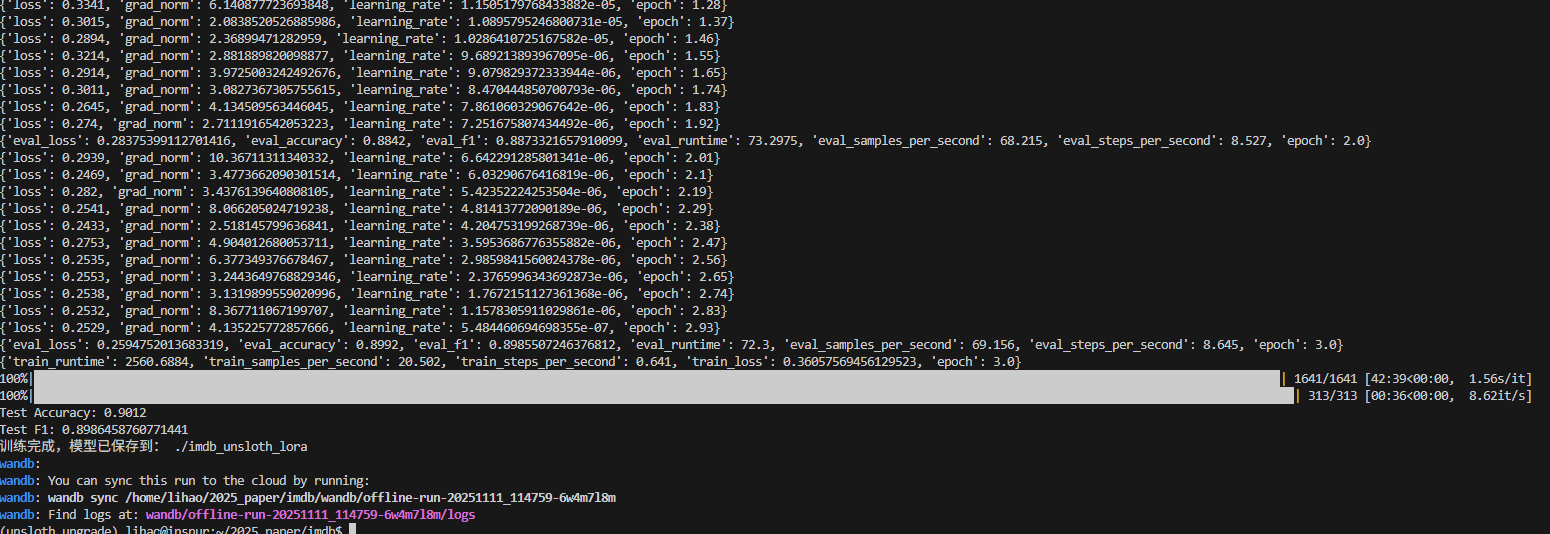
encoder-only在IMDB分类上的结果:
decoder-only在alpaca指令跟随上的结果:
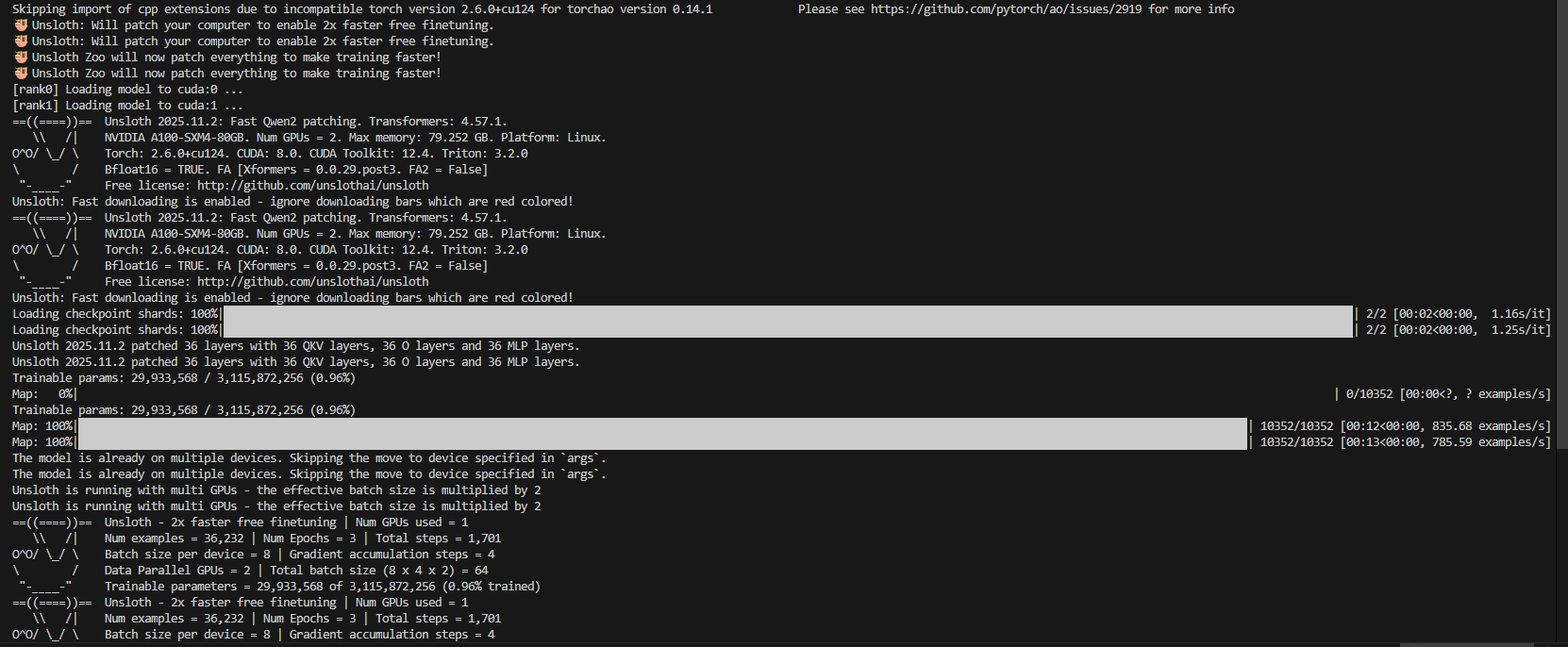
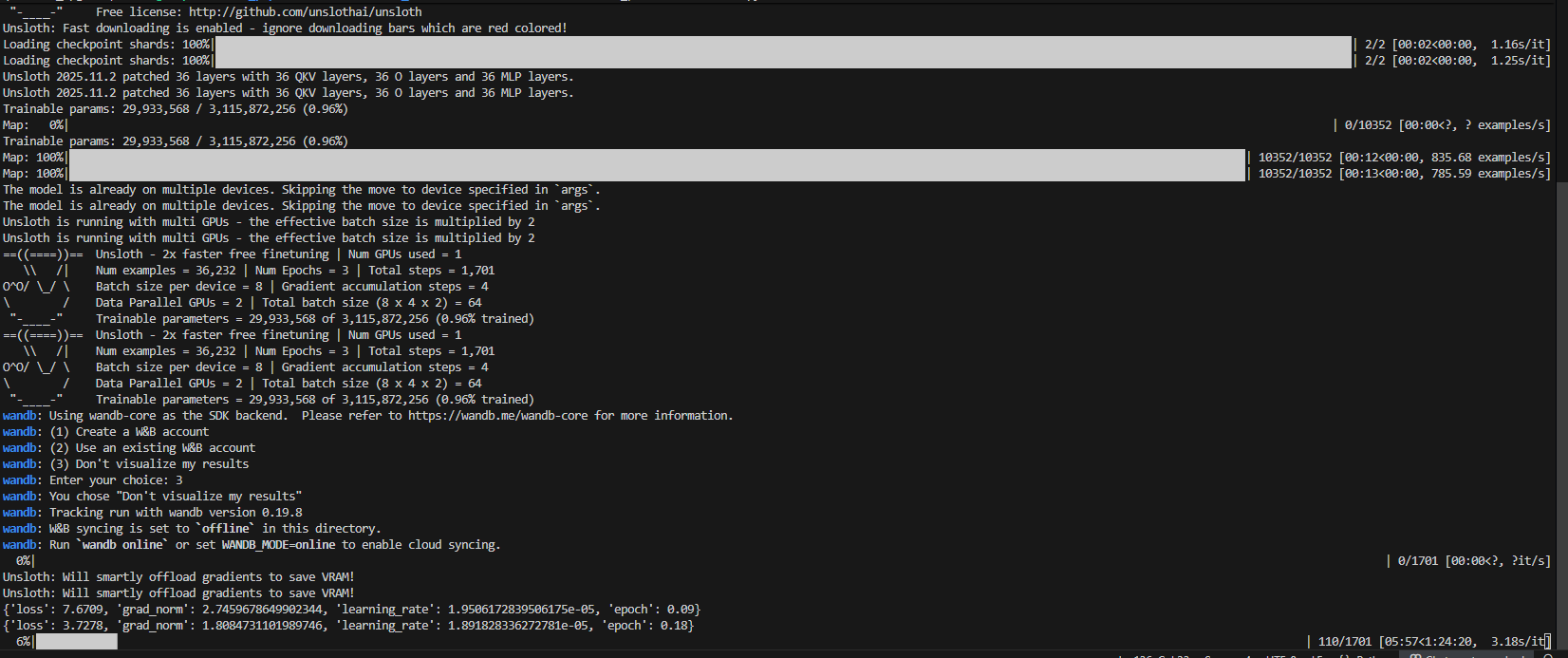
训练过程如图:
训练前后再BLEU和Rouge-L指标上的对比:


总结
- encoder-only的模型也可以使用unsloth进行训练,不过导入模型的设置不同,具体如下:
from unsloth import FastModel
from transformers import AutoModelForSequenceClassification, AutoTokenizer

# 使用 FastModel 加载带分类头的模型,full_finetuning=True 避免加载冲突

model, tokenizer = FastModel.from_pretrained(
    model_name=MODEL_NAME,
    max_seq_length=MAX_SEQ_LENGTH,
    auto_model=AutoModelForSequenceClassification,
    num_labels=NUM_LABELS,
    id2label=id2label,
    label2id=label2id,
    dtype=torch.float16, # 坑

    load_in_4bit=False,  # 启用 4-bit 量化,节省内存 # 不启用

    full_finetuning=True,  # 先完整加载,避免 auto_model 冲突

)

# 同时注意lora设置的层名称也不一样:

lora_config = LoraConfig(
    task_type=TaskType.SEQ_CLS,
    r=16,
    lora_alpha=16,
    lora_dropout=0.0,
    # target_modules=["query", "key", "value", "dense"],  # ModernBERT 注意力层

    target_modules=["Wqkv", "Wo", "Wi"],  # ModernBERT 注意力层

)
# training_args中弃用bf16,避免AMP错误:

bf16=False     # 坑禁用 BF16,避免 AMP 错误
- 目前(2025-11-11)unsloth的多GPU训练配置依旧比较繁琐,需要自己为每个进程绑定对应 GPU 设备的初始化逻辑:
# 从环境变量 LOCAL_RANK 中读取当前进程在 当前节点(机器)上的 GPU 序号。
# LOCAL_RANK 是 PyTorch 的分布式启动器(例如 torchrun 或 torch.distributed.launch)自动传入的环境变量。根据--num_processes=2 或 --nproc_per_node=4 决定。

local_rank = int(os.environ.get("LOCAL_RANK", "0"))

# 告诉 PyTorch:当前进程默认使用第 local_rank 块 GPU。

torch.cuda.set_device(local_rank)

# 构造一个设备标识字符串,例如 "cuda:0"、"cuda:1",方便打印或传入其他函数使用。

device_str = f"cuda:{local_rank}"

# 打印提示信息,说明当前进程要把模型加载到哪一块 GPU 上。

print(f"[rank{local_rank}] Loading model to {device_str} ...")
- ` ddp_find_unused_parameters=False`:是 Distributed Data Parallel (DDP) 训练中的一个重要参数设置,也是官方推荐的、启用DDP的一个必要措施。